

What Calm Screens Do to the Body
Nature on a screen triggers measurable stress recovery within four minutes. Paired with congruent audio, ambient video shifts the nervous system in ways that silence and traditional TV cannot.
If background television is the wrong answer to a real need, the next question is obvious: does a right answer exist? Can a screen provide environmental presence, warmth and texture in a room, without the cognitive costs of narrative content? There's a surprising amount of research on this, and it points in a consistent direction.
Four minutes#
In a landmark study on stress recovery, participants were shown a stressful film and then exposed to different recovery conditions. Those who viewed nature scenes on a standard television screen showed significant physiological recovery, including reduced heart rate, lower skin conductance, and decreased muscle tension, within four minutes [1]Ulrich et al. 1991 — Stress recovery during exposure to natural and urban environmentshttps://www.sciencedirect.com/science/article/abs/pii/S0272494405801847. The recovery was faster and more complete than in groups exposed to urban scenes or no visual stimulus at all.
Four minutes on an ordinary screen. Not a window, not a walk outside, not a VR headset. A television showing nature footage.
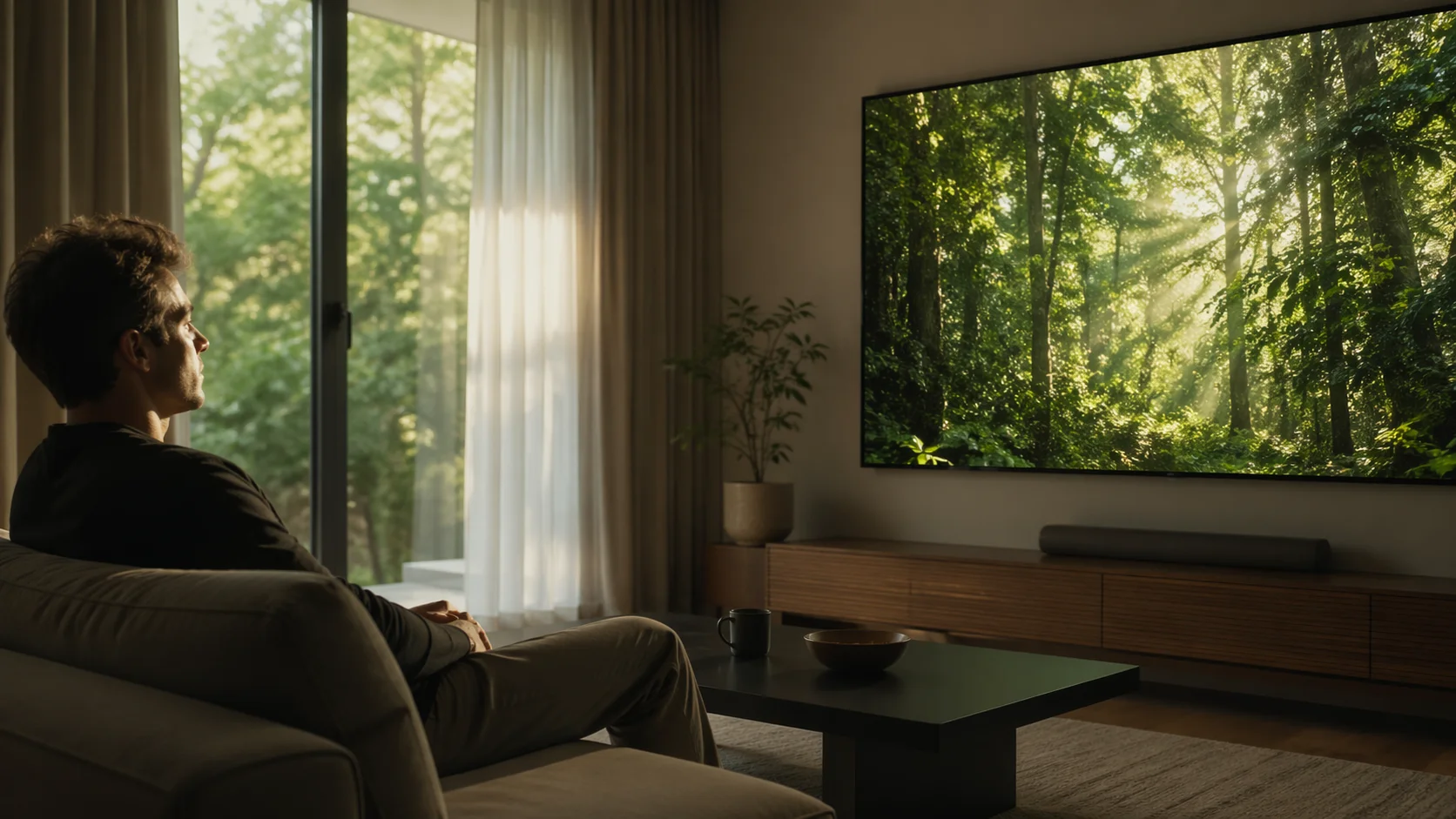 Same screen. Different content. Measurably different effect.
This finding has been replicated and extended across decades. Participants viewing nature content show 44 percent higher parasympathetic nervous system activity compared to those viewing urban environments [2]Brown et al. 2013 — Viewing nature scenes positively affects recovery of autonomic functionhttps://pubs.acs.org/doi/10.1021/es305019p. The parasympathetic system governs rest and recovery. When it's activated, heart rate slows, blood pressure drops, and the body shifts into a restorative state.
A 2023 meta-analysis pulled together findings from dozens of studies and quantified the overall effect. Exposure to nature video produced an effect size of d=-0.87 for mood disturbance and d=-0.72 for anxiety [3]Li et al. 2023, Frontiers in Psychology — Meta-analysis of nature video exposure effectshttps://www.frontiersin.org/articles/10.3389/fpsyg.2023.1176363/full. In plain language: the effect is large, reliable, and consistent across different populations and experimental designs.
The audio problem#
Here's where it gets interesting, and where most ambient video fails. Nature video without sound does almost nothing. In a study using physiological markers and cortisol sampling, participants who watched nature footage in silence showed no significant stress recovery compared to a control condition [4]Annerstedt et al. 2013 — Nature sounds facilitate stress recovery (audiovisual congruence)https://www.sciencedirect.com/science/article/abs/pii/S0272494413000340. The visual alone wasn't enough. The body needed both channels, sight and sound, working together.
It gets worse. When the audio doesn't match the visual, the effect actively reverses. Participants shown nature video paired with incongruent soundscapes (urban noise over forest footage, or mechanical sounds over ocean scenes) reported worse mood than those shown nothing at all [5]Aldoh et al. 2025, People and Nature — Audio-visual incongruence and mood effectshttps://besjournals.onlinelibrary.wiley.com/doi/10.1002/pan3.10732. The mismatch creates a perceptual conflict that the brain processes as a low-grade stressor.
Audio-visual congruence isn't a nice-to-have. It's the entire mechanism. A silent waterfall on screen is wallpaper. A waterfall with matching water sounds is an environment. A waterfall with traffic noise underneath is an irritant.
What the right sounds do#
Birdsong is worth special attention. Researchers tracked participants after exposure to birdsong recordings and found measurable improvements in mental wellbeing that persisted for up to eight hours [6]Hammoud et al. 2022, Scientific Reports — Birdsong and mental wellbeing durationhttps://www.nature.com/articles/s41598-022-20841-0. Eight hours from a sound. The evolutionary logic is straightforward: birdsong signals a safe environment. When birds are singing, there are no predators nearby. The nervous system reads birdsong as an all-clear signal and downregulates accordingly.
Fire content follows its own rules. Research on the psychological effects of watching fire found that the calming response depends heavily on the presence of crackling audio [9]Lynn 2014, Evolutionary Psychology — Hearth and campfire influences on blood pressurehttps://journals.sagepub.com/doi/10.1177/147470491401200107. A silent fireplace video produces minimal effect. Add the sound of burning wood, and blood pressure drops measurably. Fire is one of the most popular ambient video categories across streaming platforms, and the data suggests that the creators who pair it with authentic audio are doing something physiologically meaningful, while the silent loops are mostly decorative.
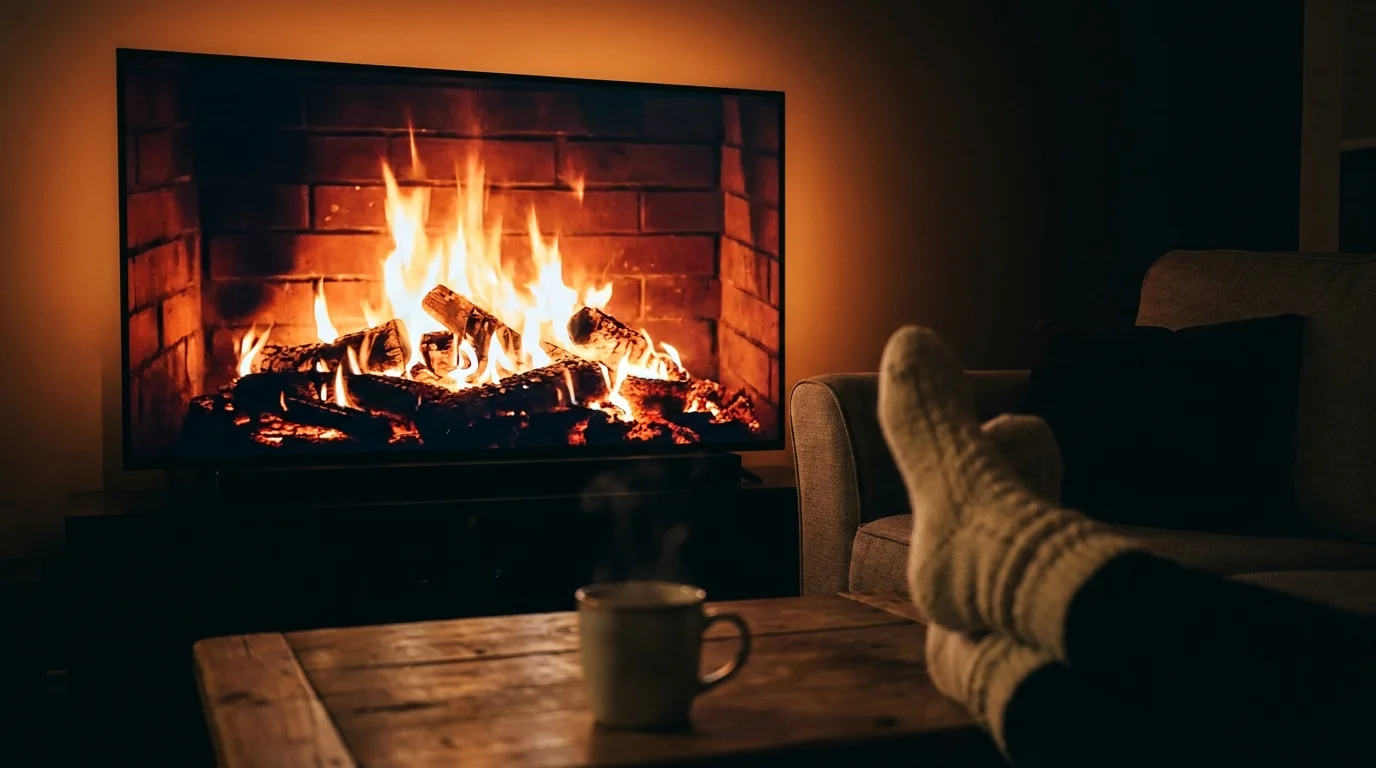 The fire only works if you can hear it.
Patterns the eye was built for#
Visual content matters too, beyond just "nature" as a category. The fractal patterns found in natural scenes, the branching of trees, the turbulence of clouds, the geometry of coastlines, produce a specific stress-reduction response. Research on fractal fluency suggests that mid-range fractal complexity, the kind found in most natural landscapes, can reduce physiological stress markers by up to 60 percent [8]Taylor — Fractal fluency and stress reduction (Interalia Magazine)https://www.interaliamag.org/articles/richard-taylor-fractal-patterns-in-nature-and-art-are-aesthetically-pleasing-and-stress-reducing/. The human visual system evolved processing these patterns for millions of years. It's tuned to find them restful.
This helps explain why certain ambient content works better than others. A slowly drifting cloud formation contains natural fractals at exactly the right complexity. A looping geometric animation does not. The eye knows the difference even when the conscious mind can't articulate it.
A different kind of productivity#
The effects extend beyond relaxation. Participants shown forest video before a task demonstrated significantly lower procrastination and higher task engagement compared to those shown urban footage, who actually procrastinated more [7]Bielinis et al. 2020 — Forest video and procrastination reductionhttps://www.mdpi.com/1660-4601/17/18/6503. The mechanism appears to be attentional restoration: nature viewing replenishes the directed attention that effortful tasks deplete, while urban and narrative content draws down that same resource.
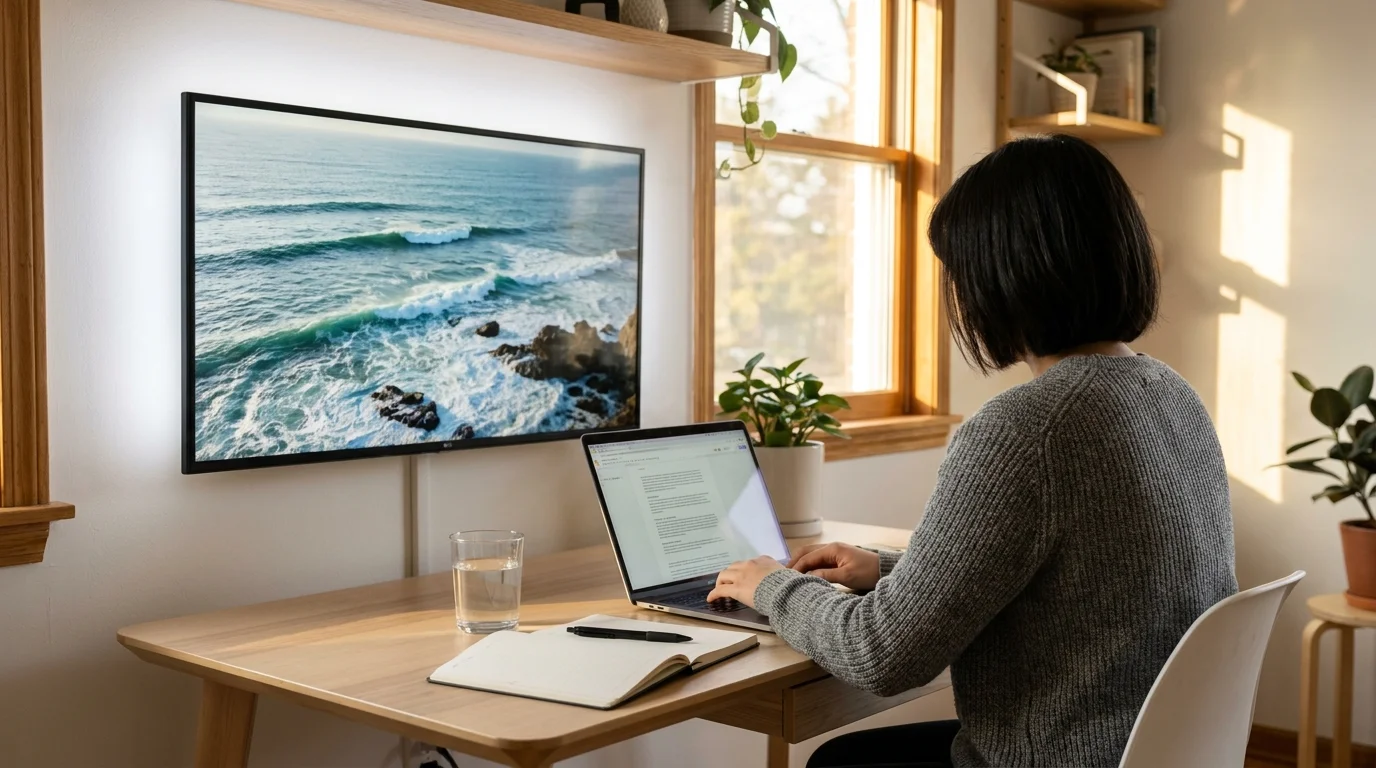 Not a distraction. A restorative backdrop.
A validated replacement#
The research is clear enough to summarize bluntly. Screens showing nature content with congruent audio produce fast, measurable stress recovery. Screens showing narrative television in the background produce measurable stress increase. The difference isn't subjective preference. It's physiology.
But knowing this doesn't solve the problem. If the science is this clear, why do most people still default to leaving Netflix or cable on instead? The answer isn't a lack of awareness. It's infrastructure. Ambient creators earn a fraction of what other categories make. Streaming algorithms actively penalize background viewing. Content policies designed for entertainment treat ambient video as spam. And the platforms hosting all of it have zero incentive to innovate for a use case they weren't built to serve. In the next post 04 — SeriesWhy Ambient Media Is StuckAmbient creators earn a fraction of what other categories make. Streaming algorithms penalize their content by design. And the platforms hosting it have no incentive to innovate for a use case they weren't built for., we can explore why ambient media is stuck despite having everything it needs to succeed.
Sources
- Ulrich et al. 1991 — Stress recovery during exposure to natural and urban environments
- Brown et al. 2013 — Viewing nature scenes positively affects recovery of autonomic function
- Li et al. 2023, Frontiers in Psychology — Meta-analysis of nature video exposure effects
- Annerstedt et al. 2013 — Nature sounds facilitate stress recovery (audiovisual congruence)
- Aldoh et al. 2025, People and Nature — Audio-visual incongruence and mood effects
- Hammoud et al. 2022, Scientific Reports — Birdsong and mental wellbeing duration
- Bielinis et al. 2020 — Forest video and procrastination reduction
- Taylor — Fractal fluency and stress reduction (Interalia Magazine)
- Lynn 2014, Evolutionary Psychology — Hearth and campfire influences on blood pressure
Early Access
Something ambient is coming.
Be the first to experience AMVI in your home.