

What Background TV Actually Does
Background television feels harmless. But eight minutes of it measurably raises stress markers, children's play degrades when a screen is on nearby, and most people who fall asleep to TV sleep worse for it.
Nobody decides to stress themselves out with television. The whole point of leaving it on is comfort, background noise, a room that doesn't feel empty. And yet the content playing in that background wasn't made to be ignored. It was made to grab and hold attention. When it plays for hours without anyone truly watching, the mismatch produces effects that are measurable, consistent, and mostly invisible to the people experiencing them.
Eight minutes#
Researchers measured cortisol levels, heart rate variability, and self-reported stress in participants exposed to background television. Within eight minutes, physiological stress markers rose significantly compared to control conditions [1]Yıldız et al. 2023, Psychophysiology — Background TV and physiological stress markershttps://www.ncbi.nlm.nih.gov/pmc/articles/PMC10515927/. The participants weren't watching. They were doing other tasks while a television played nearby. Their bodies responded anyway.
This makes physiological sense. Television audio contains constant variation: changes in pitch, volume, pacing, emotional register. News programs shift between urgency and calm. Sitcoms alternate jokes and reactions at precise intervals. Dramas build tension through silence and release. Each of these patterns is designed to modulate attention, and the autonomic nervous system doesn't distinguish between content you're watching and content you're merely near. It reacts to the stimulus.
The room where children play#
Children under two in American homes are exposed to an average of 5.5 hours of background television per day [2]Lapierre et al. 2012, Pediatrics — Background television exposure in young childrenhttps://www.ncbi.nlm.nih.gov/pmc/articles/PMC3374761/. That number includes any time a television is running in the room, whether or not the child is the intended audience. Most of the time, they're not. A parent has the news on while the child plays on the floor. A sibling watches cartoons in the next room. The screen is just there.
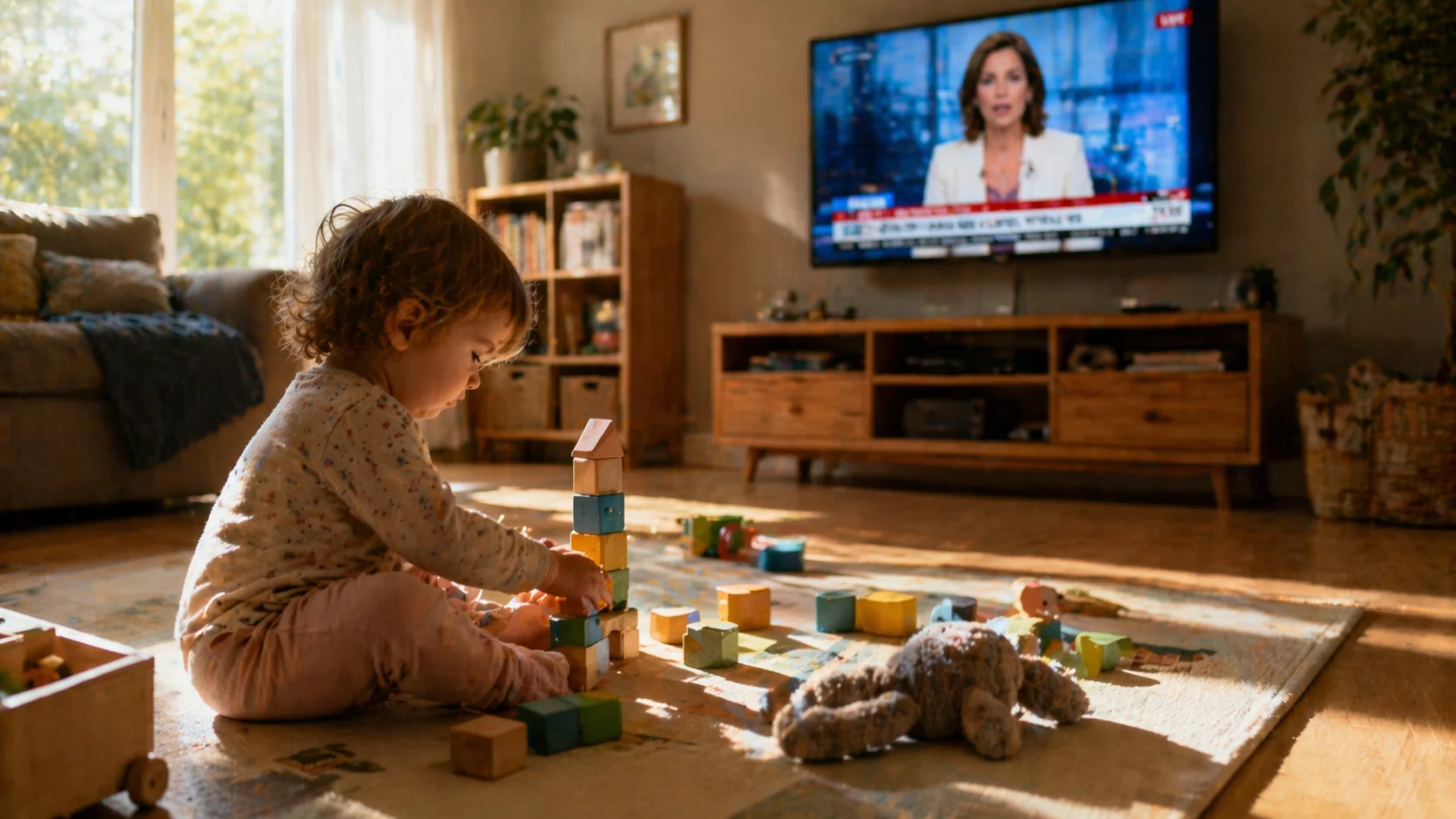 5.5 hours a day. The screen isn't for them, but it's always there.
The effects on play are immediate and observable. In controlled studies, children's focused play episodes become shorter and less complex when a television is running, even when the children glance at the screen less than 5 percent of the time [3]Schmidt et al. 2008, Child Development — Effects of background TV on play qualityhttps://pubmed.ncbi.nlm.nih.gov/18662115/. The audio pulls at their attention in irregular intervals. They don't watch, but they can't fully ignore it either. The result is a kind of fractured attention that undermines the sustained, exploratory play that matters most for development.
Parents are affected too. When a television is on in the background, the quantity and quality of parent-child verbal interaction drops. Parents speak fewer words to their children, and the words they do speak tend to be shorter and less responsive to what the child is doing [4]Pempek et al. 2014 — Background TV and parent-child interactionhttps://www.tandfonline.com/doi/abs/10.1080/17482798.2014.920715. The screen competes for adult attention just as effectively as it competes for a child's, even when the adult would say they aren't watching.
Falling asleep to noise#
Sixty-one percent of adults report falling asleep with the television on [5]Helm & Spencer 2019 — Television use and sleep in children and adultshttps://www.ncbi.nlm.nih.gov/pmc/articles/PMC6587178/. For many, it's not even a choice so much as a pattern. The show runs, the eyes close, the brain transitions into sleep while narrative audio continues playing into the room.
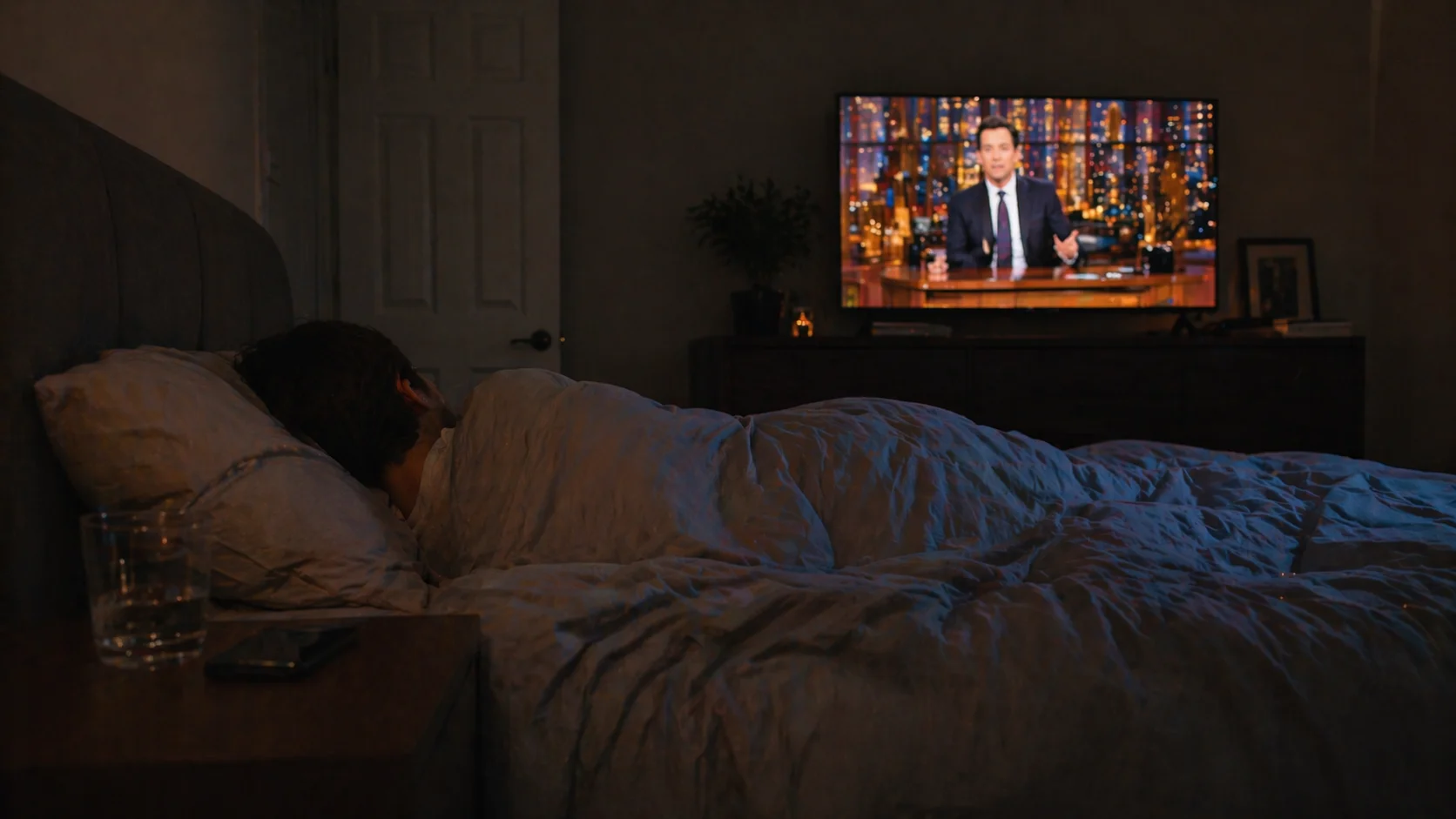 The show keeps running. The brain never fully powers down.
The cost is measurable. Children with televisions in their bedrooms sleep approximately 30 fewer minutes per night [5]Helm & Spencer 2019 — Television use and sleep in children and adultshttps://www.ncbi.nlm.nih.gov/pmc/articles/PMC6587178/. Adults who watch television in bed are 38 percent more likely to report sleeping fewer than seven hours per night [6]National Sleep Foundation 2024, Sleep Health Journal — Screen use and short sleephttps://www.sleephealthjournal.org/article/S2352-7218(23)00223-4/fulltext. A study of Norwegian university students found that each additional hour of screen use at bedtime was associated with a 59 percent increase in insomnia severity [7]AASM 2025 — Norwegian student study on bedtime screen use and insomniahttps://aasm.org/screen-time-before-bed-insomnia-norwegian-students/.
The mechanisms are layered. Blue light suppresses melatonin. Audio prevents consolidation into deep sleep. Content with emotional valence, which is nearly all narrative content, activates cortical processing at exactly the moment the brain is trying to power down. The television works against sleep at every level, and yet people keep falling asleep to it because the alternative is lying in a silent, dark room with nothing but their own thoughts. The problem from post one 01 — SeriesWhy We Leave the TV On in the BackgroundThe average American home runs a television nearly seven hours a day. Most of that time, nobody's really watching. So why can't we turn it off? hasn't gone away. It just moved to the bedroom.
The world according to the screen that's always on#
There's a subtler cost that accumulates over months and years. Cultivation theory, developed by George Gerbner in the 1970s, describes how prolonged television exposure gradually shapes viewers' perceptions of reality. People who watch more television consistently overestimate the prevalence of violence, distrust strangers at higher rates, and view the world as more dangerous than it is [8]Simply Psychology — Cultivation theory and Mean World Syndromehttps://www.simplypsychology.org/cultivation-theory.html. Gerbner called this "Mean World Syndrome."
The content washes over the viewer without triggering the analytical processing that might counterbalance its framing. Over time, the emotional residue of thousands of hours of unchosen, unprocessed content builds into a worldview that nobody consciously selected.
This isn't about individual shows being harmful. It's about the cumulative weight of narrative content running unattended in a room for years. The screen becomes a weather system: you don't notice any single day, but the climate shifts.
The gap#
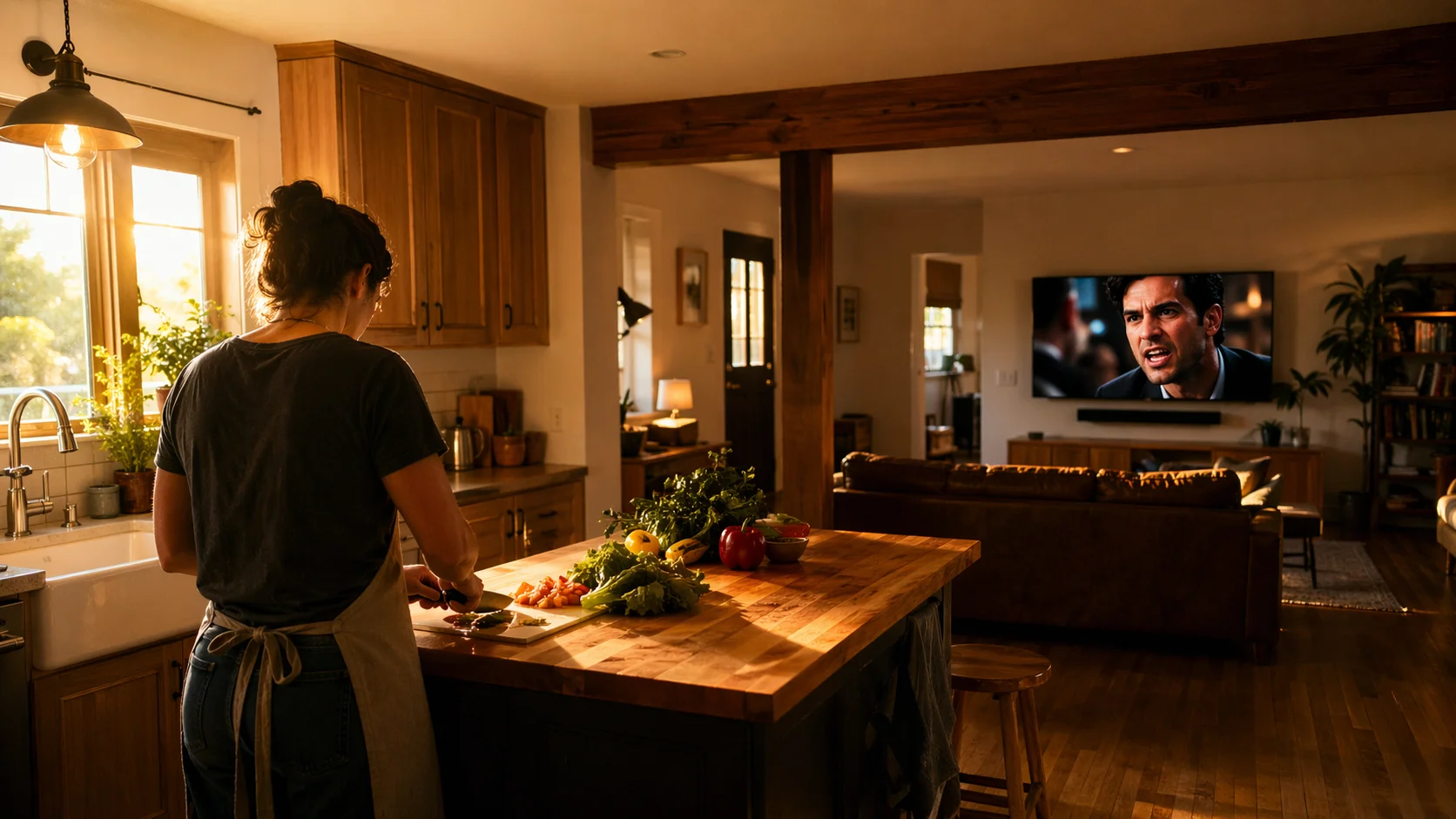 Designed to hold your attention. Playing to a room that isn't giving it any.
Every one of these effects traces back to the same structural problem. Television content is designed for attention. Its rhythms, its emotional arcs, its audio dynamics all presume someone is watching. When that content plays in the background, the design intent and the actual use case are fundamentally misaligned.
People leave the TV on because they need environmental presence. What they get is attentional content at low volume. The need is real. The harm is also real. And the obvious question is whether a screen could provide the first without producing the second.
It can. Nature footage with congruent audio triggers measurable stress recovery within four minutes. The parasympathetic nervous system activates. Blood pressure drops. The effect is large enough that a 2023 meta-analysis called it reliable across populations. In the next post03 — SeriesWhat Calm Screens Do to the BodyNature on a screen triggers measurable stress recovery within four minutes. Paired with congruent audio, ambient video shifts the nervous system in ways that silence and traditional TV cannot., the science behind what calm screens do to the body, and why audio-visual pairing is the mechanism that makes it work.
Sources
- Yıldız et al. 2023, Psychophysiology — Background TV and physiological stress markers
- Lapierre et al. 2012, Pediatrics — Background television exposure in young children
- Schmidt et al. 2008, Child Development — Effects of background TV on play quality
- Pempek et al. 2014 — Background TV and parent-child interaction
- Helm & Spencer 2019 — Television use and sleep in children and adults
- National Sleep Foundation 2024, Sleep Health Journal — Screen use and short sleep
- AASM 2025 — Norwegian student study on bedtime screen use and insomnia
- Simply Psychology — Cultivation theory and Mean World Syndrome
Early Access
Something ambient is coming.
Be the first to experience AMVI in your home.