

Why We Leave the TV On in the Background
The average American home runs a television nearly seven hours a day. Most of that time, nobody's really watching. So why can't we turn it off?
Television in the average American home is on for about seven hours a day. Not seven hours of watching. Seven hours of running. The distinction matters. For most of those hours, the screen is company, not entertainment. It fills a room with voices and movement and light while people cook, fold laundry, scroll their phones, or fall asleep.
The sound of someone being home#
Humans are wired to find comfort in voices. Newborns show preference for their mother's voice within hours of birth, a response so immediate it seems to bypass learning entirely [1]Frontiers in Psychology — review of DeCasper & Fifer 1980 on neonatal voice preferencehttps://www.frontiersin.org/articles/10.3389/fpsyg.2019.01140/full. The human voice is a safety signal. It means you are not alone, and the fact that the voice is coming from a screen instead of a person doesn't fully register with the parts of our nervous system that evolved long before television existed.
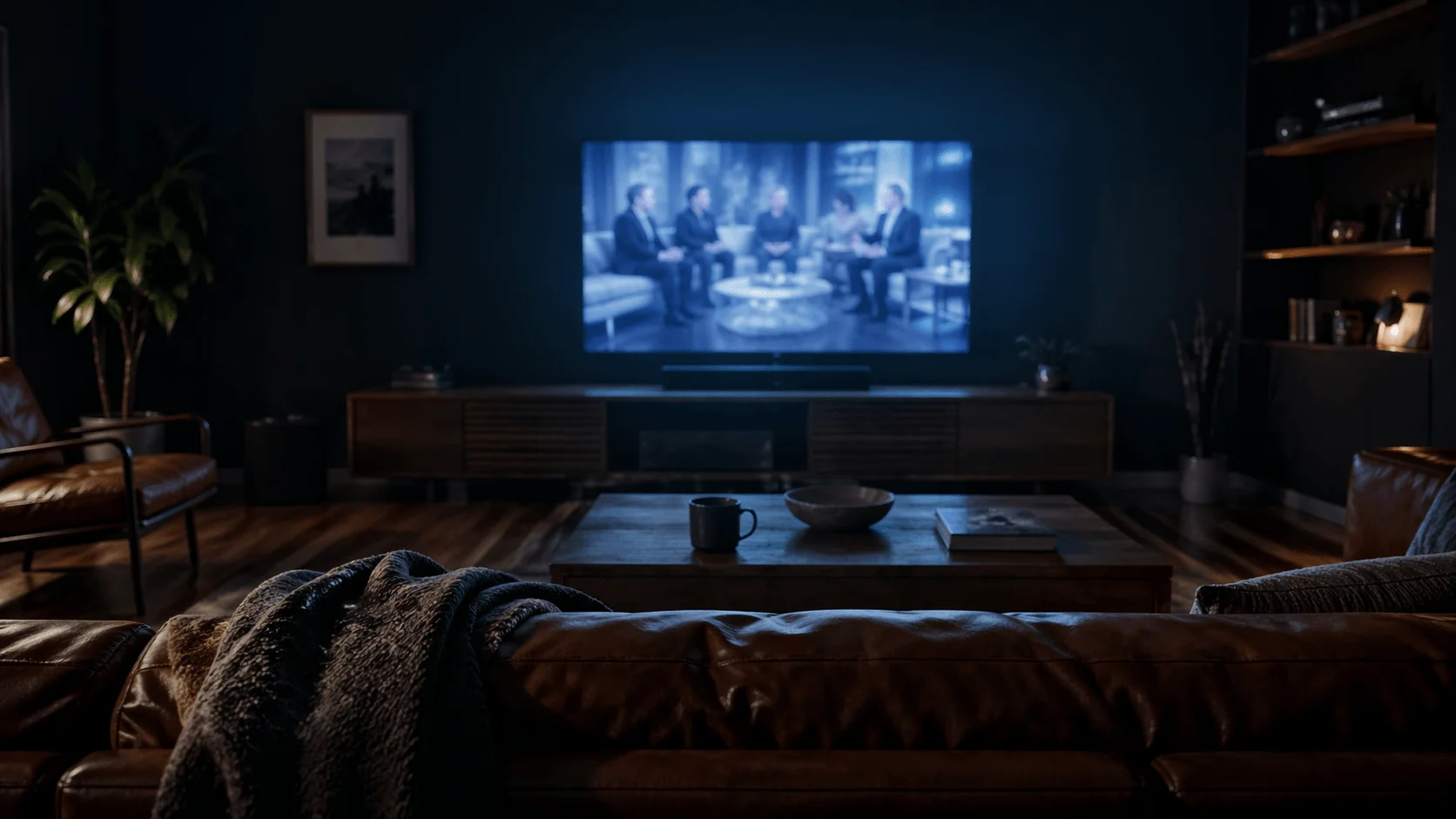 Seven hours a day, nobody watching.
Silence, by contrast, is something most people actively avoid. In a widely cited study from the University of Virginia, participants were left alone in a room with nothing but their thoughts and a button that would deliver a mild electric shock. Sixty-seven percent of men and 25 percent of women chose to shock themselves rather than sit in silence for fifteen minutes [2]Wilson et al. 2014, Science — Just think: The challenges of the disengaged mindhttps://www.ncbi.nlm.nih.gov/pmc/articles/PMC4330241/.
In a functional sense, the television becomes a prosthetic for solitude.
The comfort show and its economics#
The rise of comfort rewatching tells this story in economic terms. The Office accumulated 52 billion minutes of viewing time on Netflix before its departure to Peacock [3]PopCulture.com — The Office Netflix viewing numbershttps://popculture.com/streaming/news/the-office-netflix-viewing-numbers-exposed/. Those aren't engagement minutes in any meaningful sense. Nobody is leaning forward during the fourth viewing of a Dunder Mifflin cold open. Those are presence minutes. The show is running because the room would feel empty without it.
Surveys bear this out. Eighty-seven percent of respondents in one study reported having a "comfort show," a series they return to repeatedly not for novelty but for emotional regulation [4]CableTV.com — Comfort show surveyhttps://www.cabletv.com/blog/comfort-show-survey. The appeal isn't the plot. The appeal is predictability. When you already know what happens next, the show stops being a demand on your attention and starts being ambient. A familiar texture in the room.
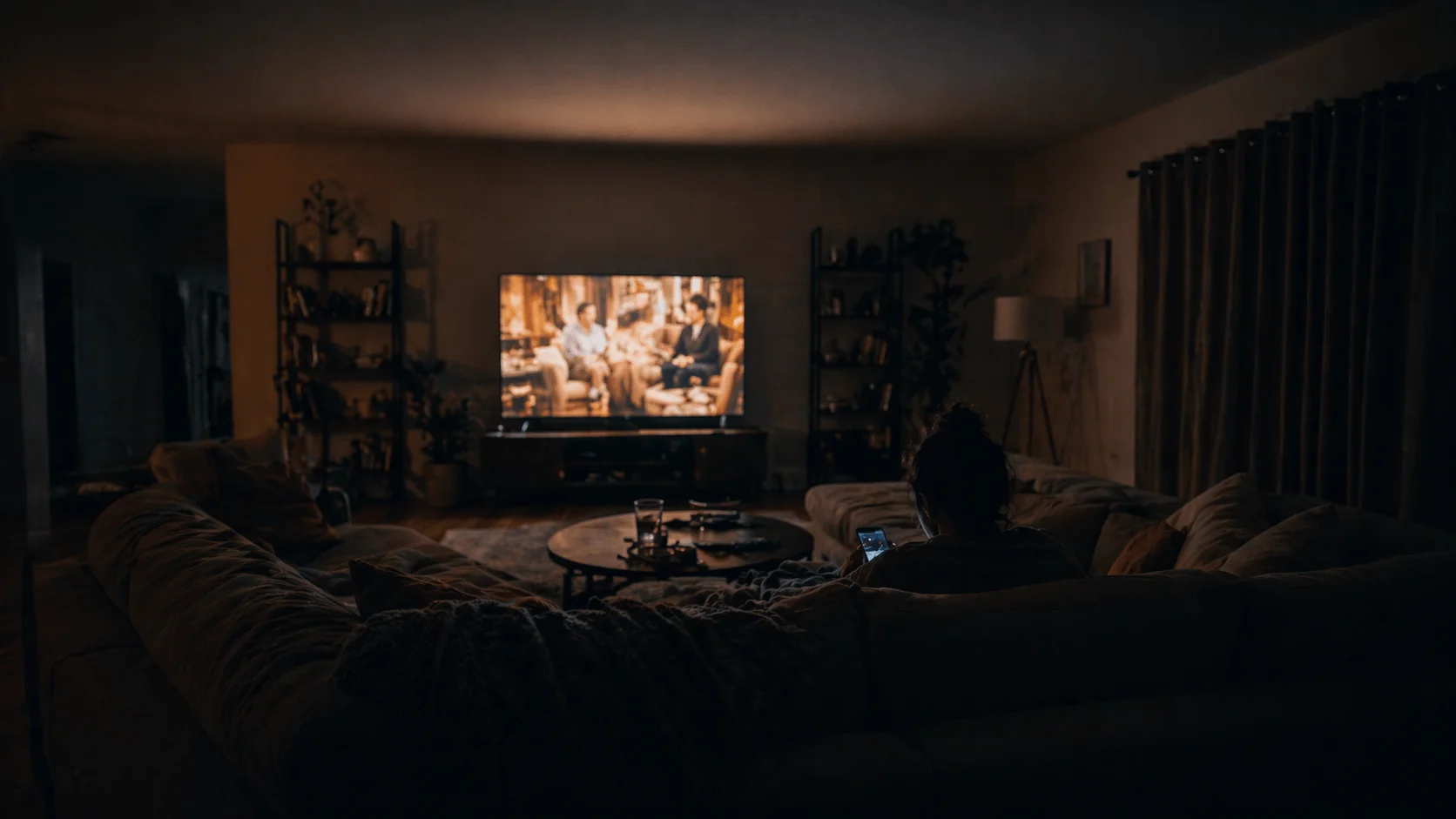 The screen fills the room so the silence doesn't have to.
There's a logic to this that goes deeper than laziness. Rewatching a known show is emotionally efficient. It provides the social presence of human voices, the background rhythm of narrative, and the warmth of familiarity, all without requiring the cognitive investment of following something new. The brain gets what it needs at the lowest possible cost.
The 70-decibel sweet spot#
The preference for moderate noise over silence has been measured precisely. Researchers at the University of Illinois found that ambient noise around 70 decibels, roughly the level of a busy coffee shop, enhances creative thinking compared to both silence and louder environments [5]Mehta, Zhu & Cheema 2012, Journal of Consumer Research — Is Noise Always Bad?https://academic.oup.com/jcr/article-abstract/39/4/784/1798502.
Television operates in this zone. A show playing in the next room, half-heard through a doorway, sits at about the right volume and complexity to serve as cognitive wallpaper. It's not that people want to watch TV while they work. They want the room to hum.
A demographic fact#
Background television isn't evenly distributed. Older adults spend roughly 37 percent of their waking hours in the presence of television, a figure that rises with age and living-alone status [6]Fingerman et al. 2021, The Gerontologist — Daily activities and social partners of older adultshttps://pubmed.ncbi.nlm.nih.gov/33367652/. For many people over 65, especially those who live alone, the television is the most consistent social presence in the home. It's the thing that's always there.
This isn't a failure of willpower or a sign of disengagement. It's a rational response to an environment that would otherwise be silent for most of the day. The TV provides what the room lacks: rhythm, voices, the feeling that something is happening somewhere.
A need with the wrong answer#
The pattern is consistent across every data point: people don't want silence, they don't want to be alone with their thoughts for hours, they want their environment to have texture and presence and warmth. These are legitimate needs. The television answers them because nothing else does.
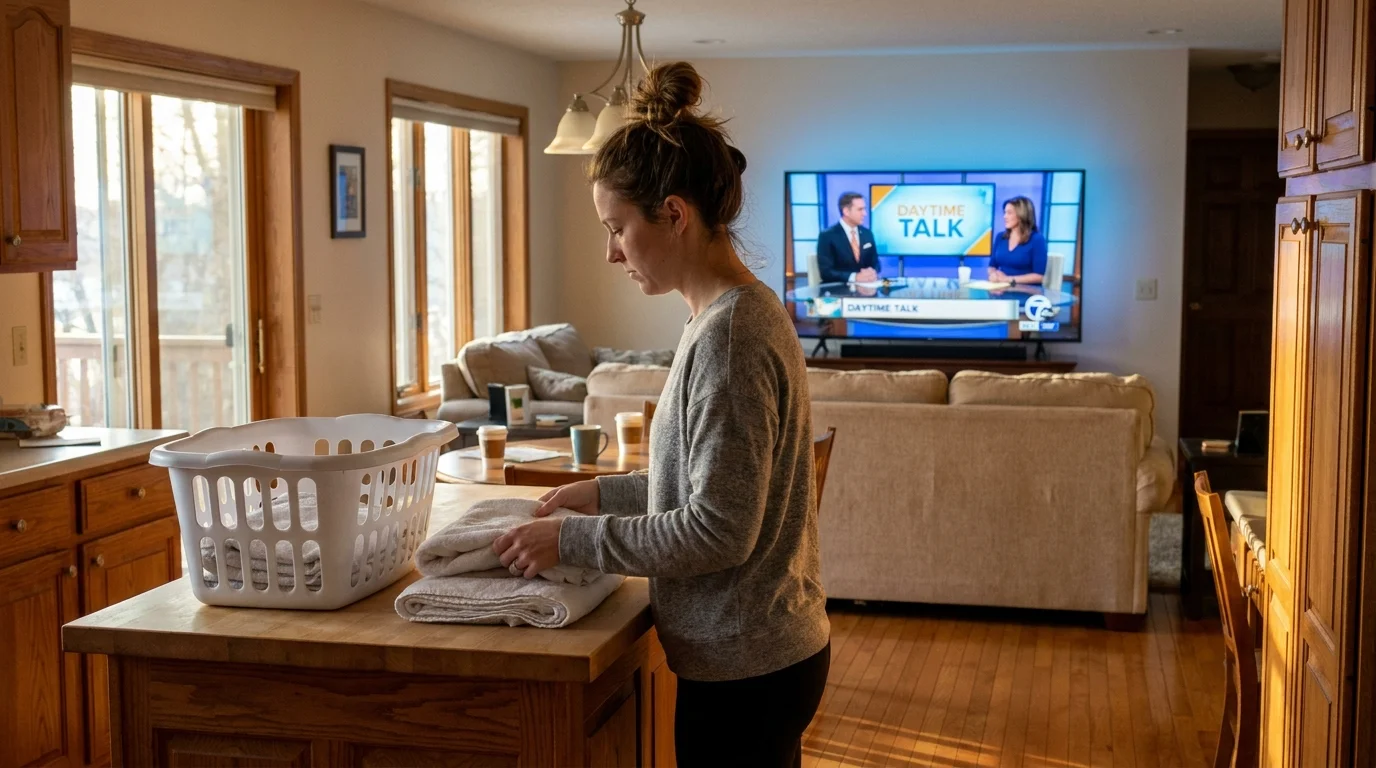 Not watching. Not willing to turn it off.
But television was designed to hold attention. Every frame, every edit, every music cue is engineered to keep eyes on the screen. When that machinery runs in the background for seven hours a day, something is mismatched. The need is environmental. The solution is attentional. People want atmosphere, and what they're getting is content.
The answer turns out to be measurable. Within eight minutes of background television, stress markers rise. Children's play degrades when a screen is on nearby. Most adults who fall asleep to TV sleep worse for it. In the next post 02 — SeriesWhat Background TV Actually DoesBackground television feels harmless. But eight minutes of it measurably raises stress markers, children's play degrades when a screen is on nearby, and most people who fall asleep to TV sleep worse for it., the research on what background TV actually does to the people in the room.
Sources
- Frontiers in Psychology — review of DeCasper & Fifer 1980 on neonatal voice preference
- Wilson et al. 2014, Science — "Just think: The challenges of the disengaged mind" (PMC)
- PopCulture.com — The Office Netflix viewing numbers
- CableTV.com — Comfort show survey
- Mehta, Zhu & Cheema 2012, Journal of Consumer Research — "Is Noise Always Bad?"
- Fingerman et al. 2021, The Gerontologist — Daily activities and social partners of older adults
Early Access
Something ambient is coming.
Be the first to experience AMVI in your home.