

Why Ambient Media Is Stuck
Ambient creators earn a fraction of what other categories make. Streaming algorithms penalize their content by design. And the platforms hosting it have no incentive to innovate for a use case they weren't built for.
Ambient video on streaming platforms is enormous. Fireplace loops, rain sounds, lo-fi streams, nature walks, coffee shop ambiance. Millions of hours, billions of views. By any raw traffic measure, the category is thriving. But behind the view counts, the economics are broken, the algorithms are hostile, and the platforms have no incentive to innovate for content they were never designed to serve.
The CPM problem#
Not all views are created equal. Advertisers pay different rates for different audiences and contexts, and ambient content sits at the bottom of the rate card. Ambient and relaxation channels earn roughly $1.21 per thousand views, compared to $13.52 for personal finance content [1]Tasty Edits — YouTube CPM rates by content categoryhttps://www.tastyedits.com/youtube-cpm-rates/. That's an eleven-to-one ratio for the same number of eyeballs.
The logic from the advertiser's side is straightforward. Someone watching a video about mortgage refinancing is in a buying mindset. Someone playing a 10-hour rain loop in the background is asleep, or at least not paying attention to the screen. The ad that plays before the rain video reaches a viewer who, by definition, isn't watching. Advertisers know this. They bid accordingly.
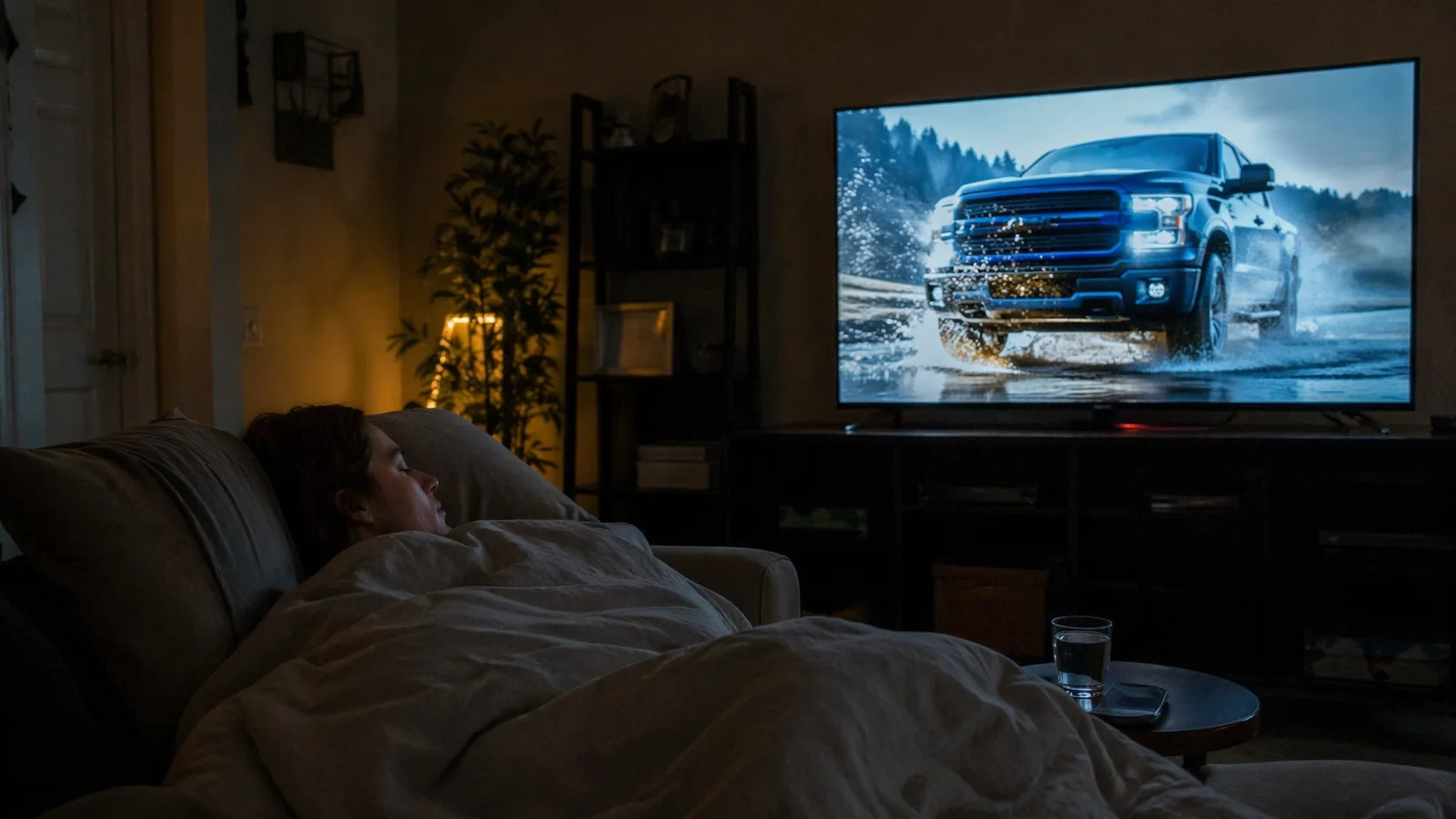 The ad reaches a viewer who, by definition, isn't watching.
This creates a structural problem that spans every ad-supported platform. The ambient videos that accumulate the most hours of viewing, the long-form loops that run overnight or all day, are precisely the videos that earn the least per hour. A 12-hour ambient video that went modestly viral earned $10,293 over eight months, and 86 percent of that revenue came from premium subscribers, not ads [2]Simon Owens Substack — The economics of a viral ambient YouTube videohttps://simonowens.substack.com/p/the-economics-of-a-viral-youtube-video. The ad model barely functions for this content.
Valued watchtime and the algorithm penalty#
Streaming platforms don't just underpay ambient content. They actively deprioritize it. YouTube uses a concept called "valued watchtime" that weights certain types of viewing more heavily than others. Background viewing, the mode in which virtually all ambient content is consumed, is explicitly discounted in this calculation [3]Beats To Rap On — YouTube valued watchtime documentationhttps://www.youtube.com/@BeatsToRapOn/community. A minute of someone actively watching a tutorial counts more than a minute of someone playing a rain loop while they sleep.
The same pattern holds across platforms. Netflix, Spotify, Amazon: every major streaming service optimizes for engagement metrics that treat passive consumption as less valuable. Ambient content is penalized for succeeding at its own purpose.
The algorithm's preferences shape content creation in concrete ways. Analysis of successful streaming content shows that platforms reward pattern interrupts every 10 to 15 seconds: cuts, zooms, text overlays, tonal shifts [4]Dataslayer — YouTube algorithm analysis 2025https://dataslayer.ai/blog/youtube/youtube-algorithm-2025. These are the rhythms of engagement-optimized video. They are the exact opposite of what ambient content should be. A good ambient video has as few interrupts as possible. The algorithms want as many as possible. The incentive structure is fundamentally adversarial.
Platform dependency and the innovation gap#
The broken economics are only half the problem. The other half is that ambient content is entirely dependent on platforms that have no reason to build features for it.
Consider what ambient media actually needs: seamless looping without buffering interrupts, time-of-day awareness so content can shift from bright afternoon to warm evening, integration with smart home systems for lighting and sound, spatial audio that adapts to room acoustics, smooth transitions between scenes that feel continuous rather than like a playlist. None of these features exist on any major streaming platform, and there's no business case for building them. Ambient viewing represents a fraction of total hours, generates the lowest revenue per hour, and would require engineering investment that serves no other content category.
This is the innovation trap. The platforms that host ambient content have no incentive to make it better. The creators who understand what ambient media should be can't build the delivery infrastructure. And the audience, which is enormous, has never experienced ambient media done well enough to know what they're missing.
The result is stagnation disguised as a content library. Millions of ambient videos exist, but the experience of consuming them hasn't meaningfully improved in a decade. The same buffering interruptions, the same autoplay recommendations pulling you out of a calm moment, the same static playlists that feel stitched together rather than designed.
The content policy squeeze#
Beyond economics and algorithms, platform content policies create additional pressure. Guidelines around "repetitious content" target videos that are "automatically generated" or offer "meaningless" repetition [5]Google Support — YouTube inauthentic/repetitious content policyhttps://support.google.com/youtube/answer/1311392. This policy was designed to combat spam, but ambient content, which often features long, slowly changing visuals by design, exists in a gray zone. Legitimate creators report anxiety about demonetization or removal for content that is, by its nature, intentionally repetitive.
The line between a beautifully filmed 8-hour fireplace and "repetitious content" isn't clear in any platform's policy language. This ambiguity functions as a tax on the category. Creators either self-censor toward shorter, more varied formats that undermine the ambient purpose, or they accept the risk of running afoul of automated enforcement.
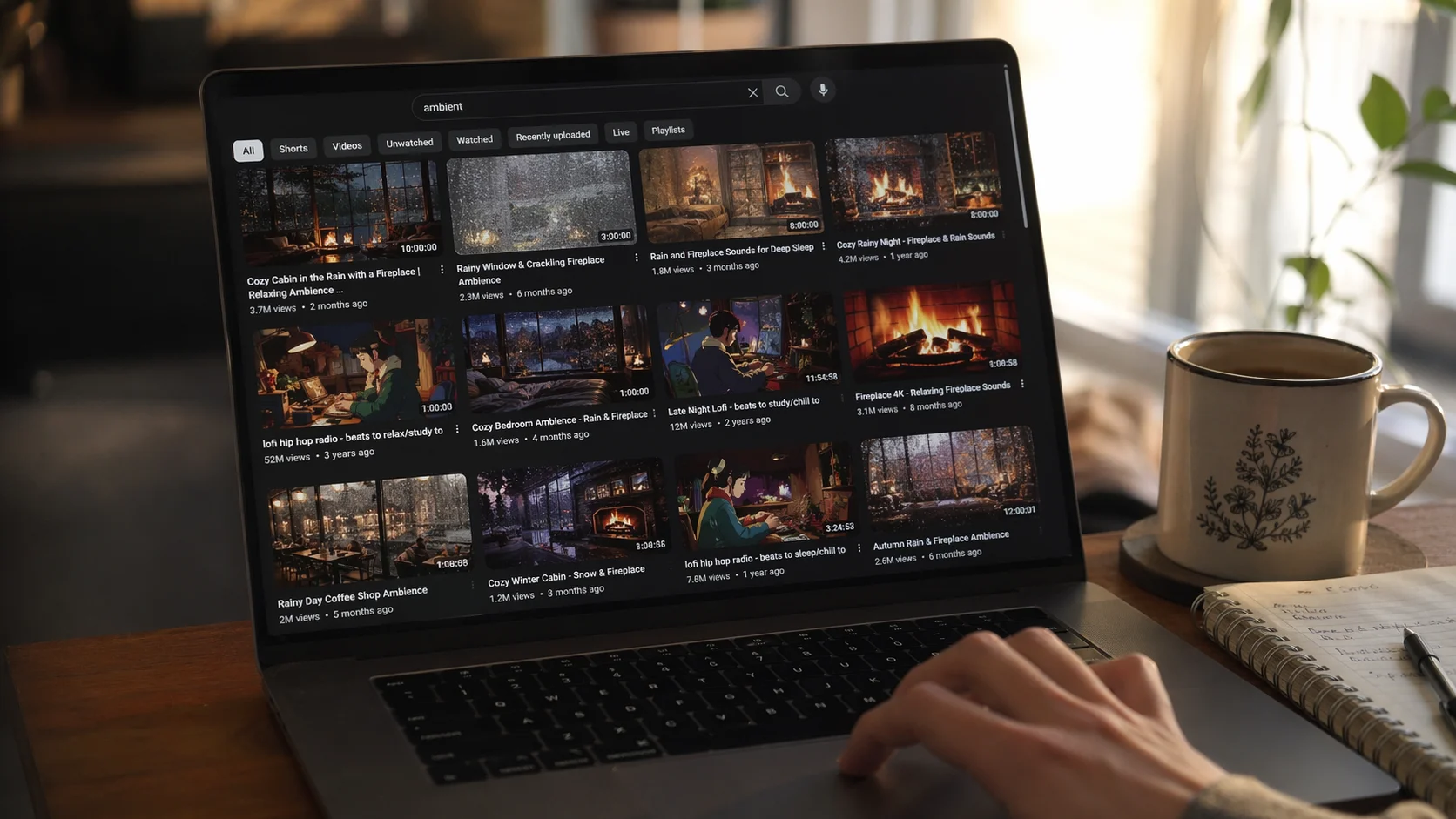 Search for "ambient" on any platform. Good luck finding what you need.
The AI flood: problem and opportunity#
The economics were already difficult. Then the AI generators arrived.
Nine of the hundred fastest-growing YouTube channels in recent analysis publish AI-generated content [6]Futurism — AI-generated content among fastest-growing YouTube channelshttps://futurism.com/youtube-fastest-growing-channels-ai. Ambient and lo-fi categories have been hit particularly hard because the bar for passable quality is lower. A lo-fi beats channel built on AI-generated music accumulated 130,000 subscribers within two months of launch [7]Daily Dot — AI lo-fi channel rapid subscriber growthhttps://www.dailydot.com/upstream/youtube-what-is-channel-lo-fi-ai/. The production cost was effectively zero.
The flood has measurable economic consequences. CPMs for lo-fi and ambient categories have dropped as supply overwhelms demand. Human creators who spend days filming in forests or composing original soundscapes compete against accounts that can publish dozens of videos per week at negligible cost.
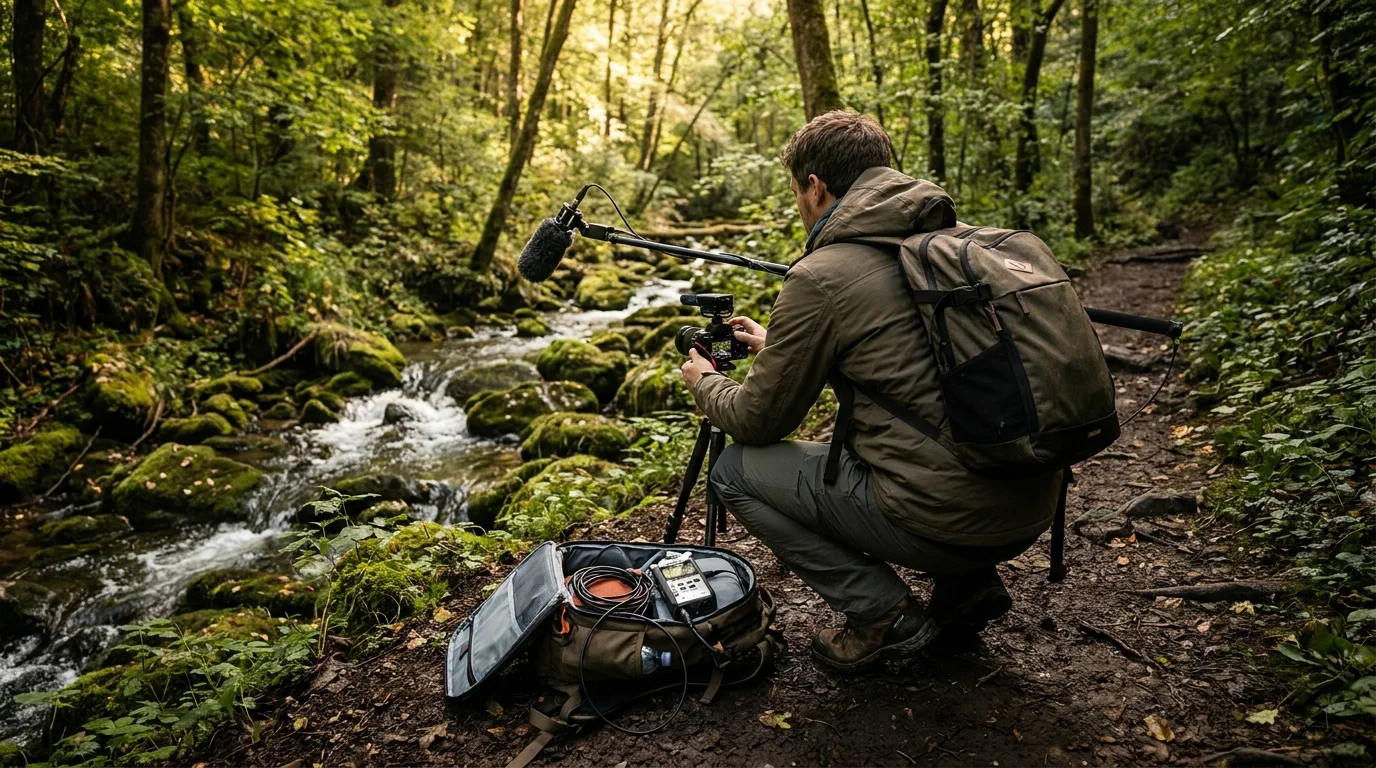 Days of work to capture one environment. Competing against accounts that publish dozens per week.
And yet AI is not merely a threat to ambient media. It's potentially the most important tool for making it better. The limitations of current AI-generated ambient content are instructive: it struggles with seamless temporal loops, favors static camera angles, defaults to a narrow range of nature scenes, and can't produce the audio-visual congruence that the research validates as essential 03 — SeriesWhat Calm Screens Do to the BodyNature on a screen triggers measurable stress recovery within four minutes. Paired with congruent audio, ambient video shifts the nervous system in ways that silence and traditional TV cannot.. These limitations reflect a lack of intent, not a lack of capability. AI applied with genuine understanding of what ambient media requires, rather than as a content multiplication shortcut, could enable experiences that are impossible to produce manually: environments that adapt in real time, respond to context, and evolve over hours without repetition.
A platform problem, not a content problem#
The ambient creators on streaming platforms aren't failing. They're producing content that millions of people want, content that has demonstrated physiological benefits03 — SeriesWhat Calm Screens Do to the BodyNature on a screen triggers measurable stress recovery within four minutes. Paired with congruent audio, ambient video shifts the nervous system in ways that silence and traditional TV cannot., content that serves a genuine and growing need. They're failing because they're operating on platforms whose economic models, algorithmic logic, content policies, and competitive dynamics are all aligned against them, and whose incentive structures preclude the innovation the category needs.
The content exists. The audience exists. The science supports it. What doesn't exist is a platform where ambient media is the primary purpose rather than an afterthought, and where innovation is driven by what ambient experiences actually require.
And yet the raw numbers tell a striking story. Billions of viewing hours, a B2B precedent already worth a billion dollars, a wellness economy valued at $6.8 trillion, CTV hardware in 90 percent of homes, and no dedicated consumer product organizing any of it. In the next post05 — SeriesA Multi-Billion-Dollar Category With No HomeAmbient video has a massive audience, proven health benefits, and adjacent markets worth trillions. It also has no dedicated platform, no community hub, and no publication covering it., the market that's waiting for someone to build what it needs.
Sources
- Tasty Edits — YouTube CPM rates by content category
- Simon Owens Substack — The economics of a viral ambient YouTube video
- Beats To Rap On — YouTube valued watchtime documentation
- Dataslayer — YouTube algorithm analysis 2025
- Google Support — YouTube inauthentic/repetitious content policy
- Futurism — AI-generated content among fastest-growing YouTube channels
- Daily Dot — AI lo-fi channel rapid subscriber growth
Early Access
Something ambient is coming.
Be the first to experience AMVI in your home.